
For Residential, Corporate and Institutional Spaces
Every space has its own sonic signature, influenced by its size, shape, construction materials, and contents. Sound waves tend to bounce back and forth between hard, parallel surfaces, sometimes causing excessive reverberation and audible echoes. Direct sound from speakers and reflections from hard surfaces combine to reinforce some frequencies and cancel others, resulting in uneven frequency response. These issues make speech harder to understand, mask musical detail, and undermine the immersive listening experience that surround sound and stereo systems are engineered to deliver.
Whether it’s at work or at home, the quality of listening or communication within a space is directly affected by its acoustic behaviour. Optimising that behaviour requires intentional design – not guesswork – which is where professional acoustic treatment comes in.
How Acoustic Treatment Works
Acoustic treatment is not about filling a room with foam or panels — it’s about making precise, purposeful interventions that optimise the room’s acoustic characteristics for its intended purpose. This means identifying the surfaces and areas that contribute most to reflections, reverberation, and low‑frequency cancellations, then introducing targeted absorption and diffusion through wall panels, ceiling panels, and bass traps. The goal is to improve sound clarity, tonal balance, and spatial accuracy without altering the room’s structure or aesthetic intent.
Soundproofing
vs
Acoustic Treatment
Soundproofing is a construction process designed to reduce the transmission of sound into or out of a room.
Acoustic treatment focuses on the quality of sound within a room by managing reflections, reverberation and resonance.
Applications
At Audissey, we design and implement precisely tailored acoustic treatment solutions for a range of environments, including:
- Home Cinemas and Media Rooms
- High‑Fidelity Stereo Listening Rooms
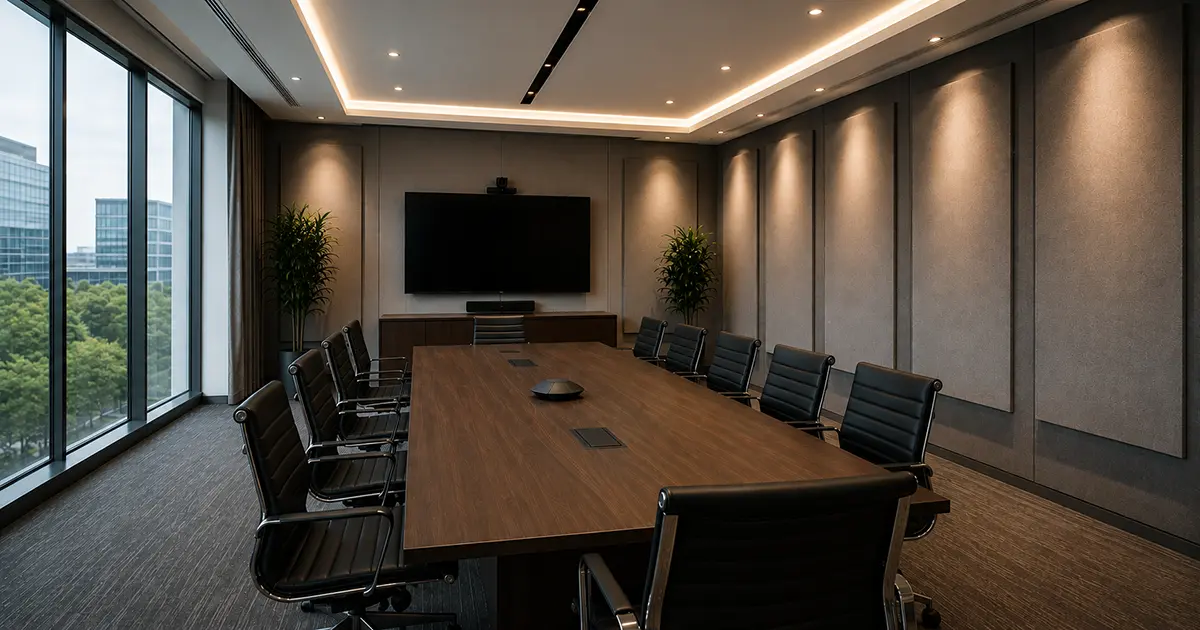
- Boardrooms and Meeting Rooms
- Classrooms and Training Spaces
Solutions
Our acoustic treatment solutions are based primarily on custom-designed wall and ceiling panels, constructed using sound-absorbing materials available in different colours. We are happy to work with you to determine the panel design, quantity and placement that best suits the requirements of your space.
In the case of new constructions, we can also provide guidance on optimum room geometry, dimensions, and materials to achieve better acoustic behaviour from the ground up.
If you’re building a new space or looking to improve the acoustics of an existing one, talk to us – we’d be glad to help you shape the right solution. Or if you prefer to take the DIY approach, you can order our ready-to-hang acoustic wall panels and install them as you wish.